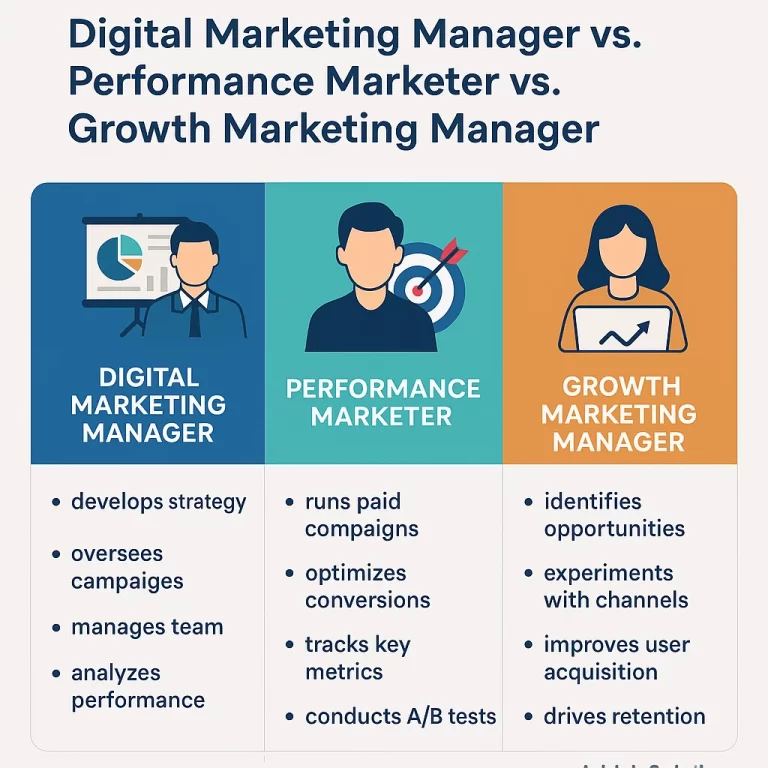
Understanding the Roles in Digital Marketing: Digital Marketing Manager vs. Performance Marketer vs. Growth Marketing Manager
In today’s dynamic digital landscape, businesses rely on specialized roles to drive visibility, engagement, and revenue. While job titles like Digital Marketing Manager, Performance Marketer, and Growth Marketing Manager might sound similar, they each bring distinct value to an organization’s success.
In this article, we’ll explore the roles, responsibilities, differences, and similarities between these three essential positions in modern digital marketing.
📌 1. Digital Marketing Manager (DMM)
🧭 Overview:
The Digital Marketing Manager is the architect behind a brand’s online presence. They plan and oversee comprehensive digital strategies that cover all online channels to achieve brand and business goals.
🛠️ Key Responsibilities:
-
Strategic Planning: Develop a unified digital strategy that encompasses SEO, SEM, content marketing, social media, email, and more.
-
Team Leadership: Manage content creators, designers, SEO/SEM experts, and other digital specialists.
-
Campaign Management: Execute and optimize multi-channel campaigns.
-
Analytics & Reporting: Track KPIs using tools like Google Analytics, GA4, SEMrush, and others.
-
Budget Allocation: Distribute and monitor digital marketing budgets for optimal ROI.
-
Cross-Department Collaboration: Coordinate with sales, development, and product teams.
-
Brand Consistency: Maintain brand tone and messaging across all digital touchpoints.
✅ Best For:
Companies needing a generalist leader to oversee comprehensive digital efforts.
📌 2. Performance Marketer
🧭 Overview:
A Performance Marketer is a data-driven specialist focused on generating measurable results through paid channels. Their primary goal is to maximize return on ad spend (ROAS) and minimize customer acquisition cost (CAC).
🛠️ Key Responsibilities:
-
Ad Campaign Execution: Launch and optimize paid ads across Google Ads, Meta (Facebook & Instagram), YouTube, and more.
-
A/B Testing: Experiment with different ad creatives, audiences, CTAs, and landing pages.
-
Data Analysis: Use tools like GA4, Facebook Pixel, Google Tag Manager, and ad platforms to track results.
-
Funnel Optimization: Improve performance at every stage from impression to conversion.
-
Retargeting & Remarketing: Re-engage users who didn’t convert in the first interaction.
-
Performance Metrics Monitoring: Track CPC, CTR, CPM, ROAS, and CPA metrics closely.
✅ Best For:
Businesses with aggressive lead generation, eCommerce, or ROI-focused advertising goals.
📌 3. Growth Marketing Manager
🧭 Overview:
The Growth Marketing Manager operates at the intersection of marketing, product, and analytics. Unlike traditional marketers, their mission is full-funnel growth, from user acquisition to long-term retention and revenue optimization.
🛠️ Key Responsibilities:
-
Full-Funnel Optimization: Focus on the entire user journey using the AARRR model (Acquisition, Activation, Retention, Referral, Revenue).
-
Experimentation: Run rapid growth experiments—landing page tweaks, new onboarding flows, pricing models, etc.
-
Data Analysis: Use tools like Mixpanel, Amplitude, GA4, SQL, and BI dashboards.
-
Lifecycle Campaigns: Set up email drips, SMS campaigns, push notifications, and in-app messages.
-
Product Collaboration: Work with product teams to optimize features for better user engagement and conversion.
-
Referral/Viral Loops: Encourage user-generated growth via referral and reward programs.
✅ Best For:
Startups and tech companies aiming for scalable, sustainable, and product-led growth.
🆚 Key Differences: DMM vs. PM vs. GMM
| Criteria | Digital Marketing Manager | Performance Marketer | Growth Marketing Manager |
|---|---|---|---|
| Primary Focus | Overall digital strategy | Paid marketing and ROI | Full-funnel growth |
| Scope | Broad, multi-channel | Narrow, paid-only focus | Broad + product/data integration |
| Key Channels | SEO, Social, Email, Web, Ads | Meta Ads, Google Ads, YouTube | Product, Email, Referrals, Ads |
| Success Metrics | Traffic, visibility, brand reach | ROAS, CPA, conversion rate | LTV, retention, activation rate |
| Tools Used | GA4, SEMrush, Mailchimp, Hootsuite | Facebook Ads, GTM, Google Ads | Mixpanel, Amplitude, SQL, GA4 |
| Mindset | Managerial, strategic | Analytical, ROI-focused | Experimental, growth-hacker |
🔁 What Makes Them Similar?
Despite their differences, these roles share some foundational traits:
| Shared Element | Description |
|---|---|
| Data-Driven | All use analytics to measure success and guide decision-making. |
| Digital Channel Expertise | Proficiency in multiple online platforms and tools. |
| Goal-Oriented | Focused on delivering measurable business results. |
| Collaborative | Work with design, development, and product teams. |
| User-Centric | Understand and optimize user journeys and customer experiences. |
🚀 Which Role Do You Need for Your Business?
The answer depends on your stage, goals, and resources:
-
📌 For branding, visibility, and full-channel coverage → Hire a Digital Marketing Manager.
-
📌 For paid media growth and lead generation → Choose a Performance Marketer.
-
📌 For long-term scalable growth and product-led marketing → Opt for a Growth Marketing Manager.
🧠 Final Thoughts
Each of these roles plays a crucial part in driving digital success. While a Digital Marketing Manager ensures the ship stays on course, a Performance Marketer acts as a precision striker focused on revenue, and a Growth Marketing Manager brings innovation and experimentation to fuel rapid expansion.
Businesses that understand these differences can build more effective teams, allocate resources smartly, and ultimately drive better ROI from their marketing efforts.
Need help hiring for these roles or building your digital strategy?
Feel free to contact us – we’d love to help you grow!