Google Shopping Product Segmentation: The Key to Unlocking Hidden Profitable Products
Product segmentation is one of the most powerful yet underutilized strategies in Google Shopping campaigns. At Addeb Solution, we’ve helped businesses discover hidden profitable products that were being overshadowed by high-volume items. This guide explains what product segmentation is, why it’s critical for campaign success, and how to implement it effectively.
What Is Product Segmentation?
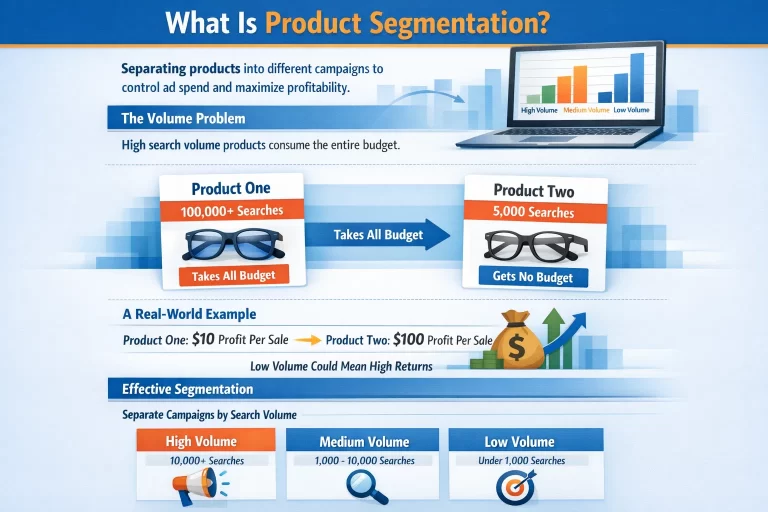
Product segmentation is the practice of separating products into different campaigns to ensure even distribution of your ad budget. When all products share a single campaign, they compete for the same budget, and Google’s algorithm doesn’t distribute spending equally—it prioritizes based on search volume.
The Volume Problem
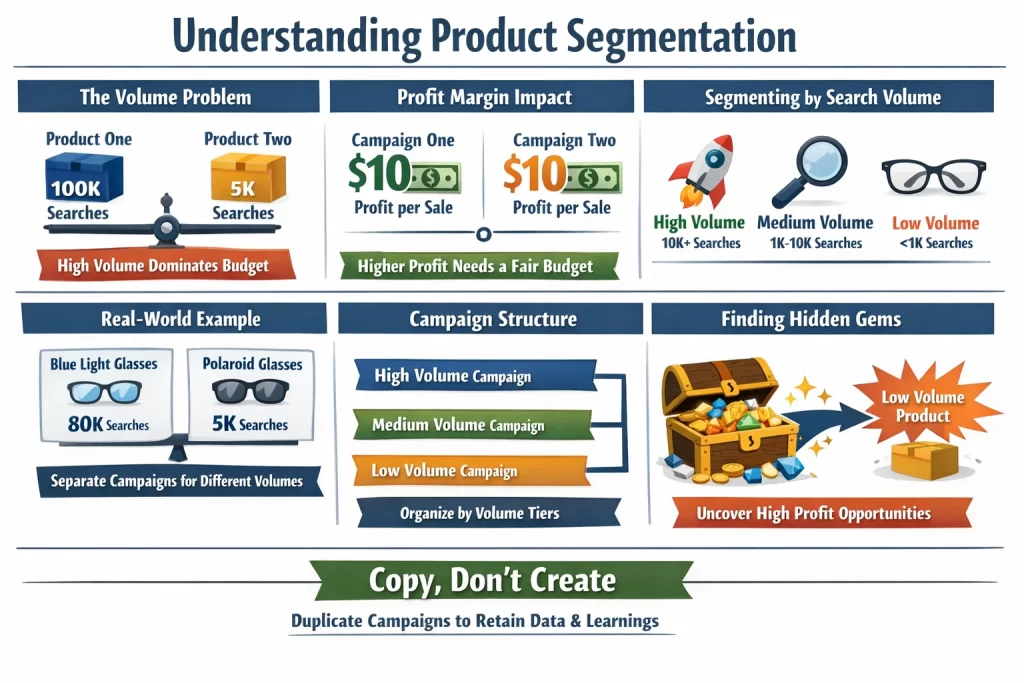
Google categorizes products by search volume potential. If one product has massive search volume while another has limited searches, Google directs the entire budget toward the high-volume product. This creates a critical problem: your potentially most profitable products might never get a chance to prove themselves.
A Real-World Example
Consider two products in the same campaign. Product One receives 10,000-100,000 monthly searches, while Product Two only gets 1,000-10,000 monthly searches. These numbers come from automated keywords Google extracts from your product pages.
Product One receives the vast majority of your budget simply because it has the most search volume—it’s the lowest hanging fruit. But what if Product Two has an exceptional conversion rate and represents your highest-profit opportunity? Without segmentation, you’ll never discover this because Product Two never receives adequate budget allocation to demonstrate its potential.
Why Profit Margins Change Everything
Product segmentation becomes even more critical when considering profit margins. Different products often have dramatically different profit values, which means lower traffic can still generate superior returns.
Imagine Campaign One (high volume product) generates $10 profit per sale, while Campaign Two (low volume product) generates $100 profit per sale. Campaign Two needs far fewer sales to be incredibly valuable, but it requires a separate budget for Google to spend money there consistently.
This scenario often results in vastly different ROAS performance. Campaign Two might achieve much better return on ad spend, but you’d never discover this without proper segmentation. The high-volume product would consume your entire budget, leaving the high-profit product starved for investment.
How to Segment by Search Volume
Effective segmentation starts with categorizing products by search volume, typically into high, medium, and low volume categories.
Simple Two-Product Example
If you’re researching blue light blocking glasses, you might find that “blue light blocking glasses” has 10,000-100,000 monthly searches, and “3D glasses” also has 10,000-100,000 searches. However, “polaroid glasses” only has 1,000-10,000 monthly searches.
This volume difference means polaroid glasses needs its own campaign with a dedicated budget to receive fair representation in your advertising strategy.
Understanding Search Volume Estimates
Don’t worry if the search volume numbers show as estimates. Google always provides estimates initially, even after you start spending. Once your campaigns are active and generating data, you’ll receive more precise numbers, but they’ll still be estimates rather than exact figures. This is normal and shouldn’t prevent you from making segmentation decisions.
Segmenting Complex Product Catalogs
For stores with multiple categories and subcategories, segmentation requires additional layers of organization. Let’s examine how this works using a technology retailer like Logitech as an example.
The Multi-Level Approach
Start by identifying your main categories: mice, keyboards, webcams, and audio products. For each category, research the average monthly search volume for every product model using Google’s Keyword Planner tool.
Create a simple spreadsheet with columns for category, product name, and search volume. Under “keyboards,” list each model with its corresponding volume. Repeat for mice, audio, and other categories.
You’ll notice patterns emerge: some products have high volume (10,000+ searches), others have mid-range volume (1,000-10,000 searches), and some have low volume (under 1,000 searches). These three tiers become separate campaigns.
The Final Structure
Your campaign architecture would include keyboards – high volume campaign, keyboards – medium volume campaign, keyboards – low volume campaign, and the same structure repeated for each product category.
Within each campaign, ad groups contain the specific products matching that volume tier. This structure ensures products with similar search volumes compete together rather than being overwhelmed by higher-volume items.
Implementation Best Practice: Copy, Don’t Create
When segmenting existing campaigns, never create new campaigns from scratch. Always copy and duplicate your existing campaign. This critical step preserves all accumulated campaign data, learning, and optimization history.
If you’ve been running a campaign for weeks or months, that data is valuable. Creating a fresh campaign discards this learning and forces Google’s algorithm to start over. Duplicating maintains continuity while allowing you to segment products appropriately.
After duplicating, you’ll remove products that don’t match each campaign’s volume tier, leaving only the appropriate products in each segmented campaign.
When Segmentation Matters Most
Even businesses with just a few products should segment if those products have significantly different search volumes. The volume differential, not the number of products, determines whether segmentation provides value.
Two products with similar search volumes can share a campaign comfortably. Two products with 10X volume differences should absolutely be separated, regardless of how small your catalog is.
Finding Your Hidden Gems
Product segmentation often reveals surprising insights. That low-volume product you barely thought about might convert at 5X the rate of your main offering. That expensive item with limited searches might generate your highest profit per sale.
Without segmentation, these opportunities remain hidden beneath the weight of high-volume products consuming your budget. Proper segmentation gives every product a fair chance to prove its value, often uncovering profit centers you didn’t know existed.
Conclusion
Product segmentation is essential for maximizing Google Shopping campaign profitability, especially for multi-product stores. By separating products into campaigns based on search volume and ensuring each receives dedicated budget allocation, you prevent high-volume products from overshadowing potentially more profitable low-volume items.
At Addeb Solution, we’ve consistently seen segmentation reveal hidden profit opportunities and dramatically improve overall campaign ROAS. The upfront work of researching search volumes and organizing campaigns pays dividends through better budget distribution and the discovery of your true profit drivers.