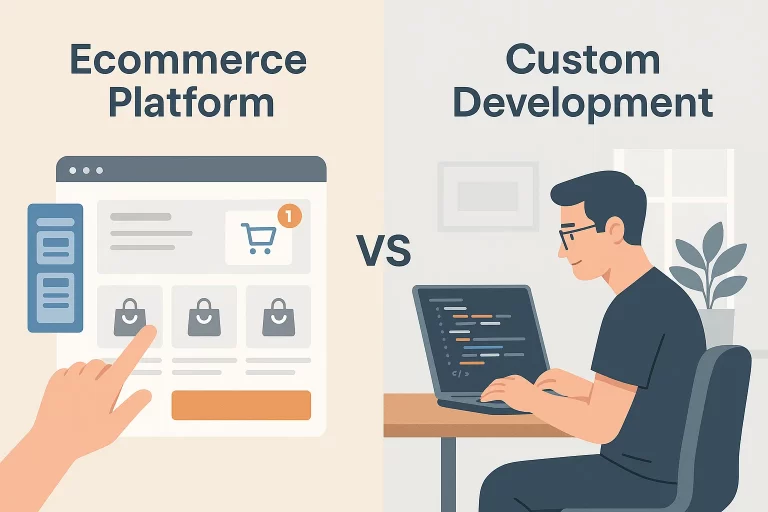
Ecommerce Platform vs Custom Development: Which is Best for Your Business?
Choosing the right foundation for your ecommerce business can define your growth, profitability, and brand experience. Should you launch your store using a platform like Shopify, WooCommerce, or Magento, or should you invest in a custom-built ecommerce website using Laravel, MERN, or similar frameworks?
As a digital marketer, I see this question frequently when brands plan to scale. Here’s a practical, no-fluff breakdown to help you decide based on your budget, timeline, scalability, and marketing goals.
1️⃣ Speed and Technical Performance
-
Ecommerce Platforms:
Shopify and WooCommerce offer fast, optimized infrastructure with CDNs, image compression, and mobile responsiveness out of the box. This lets you launch quickly and maintain good loading speeds, which supports SEO and conversions without additional tech headaches. -
Custom Development:
With a well-built Laravel or MERN stack, you can fine-tune server performance, caching, and database optimization for blazing-fast speeds. A headless architecture (e.g., Next.js frontend with a custom backend) can deliver exceptional performance for large catalogs or advanced user experiences.
2️⃣ Conversion Rates
-
Ecommerce Platforms:
Shopify and WooCommerce offer conversion-optimized checkout flows, abandoned cart recovery, mobile-friendly designs, and app integrations for upselling and social proof, helping you convert visitors into customers easily. -
Custom Development:
You get full control over your checkout and customer journey, enabling you to design custom checkout flows, gamified experiences, or personalized funnels if you have CRO expertise.
3️⃣ Scalability
-
Ecommerce Platforms:
Platforms like Shopify Plus can handle large sales volumes, flash sales, and seasonal spikes without downtime or performance issues. -
Custom Development:
A custom solution allows for infinite scalability with proper architecture (load balancing, caching, serverless functions), making it suitable for enterprise-level businesses with large traffic and complex operations.
4️⃣ Features and Flexibility
-
Ecommerce Platforms:
You get robust built-in features, and you can expand functionality using apps or plugins. However, you might hit limitations when attempting to implement advanced workflows or unique user experiences. -
Custom Development:
You can build any feature or workflow you envision, integrate deeply with ERP, CRM, or warehouse systems, and design a unique brand experience.
5️⃣ Cost of Development and Maintenance
-
Ecommerce Platforms:
✅ Low upfront costs.
✅ Fast go-to-market.
❌ Ongoing app and platform fees can add up as you scale. -
Custom Development:
❌ Higher upfront investment.
❌ Longer time to launch.
✅ Lower ongoing fees, full control, and ROI at scale.
What Should You Choose?
🚀 If you have a low budget and need to launch fast:
✅ Go with Shopify or WooCommerce.
You will save time, reduce upfront costs, and focus your energy on marketing, content, and building your customer base. Once you validate your product-market fit, you can consider advanced customization later.
🏗️ If you have a strong budget and ample time:
✅ Invest in custom development using Laravel, MERN, or a headless stack.
This approach allows you to create a unique customer experience, advanced features, and complete control over scalability and performance, helping you build a brand that stands out.
Real-World Examples:
-
Gymshark: Started on Shopify, moved to a custom headless architecture as they scaled globally.
-
Amazon & Flipkart: Fully custom-built due to the complexity and scale of their operations.
-
Thousands of small brands: Operate profitably on Shopify without ever needing to move.
Final Thoughts as a Digital Marketer
Your ecommerce success depends more on your offer, marketing, and customer experience than on your tech stack alone.
✅ If you’re testing, validating, or growing steadily—start with a platform.
✅ If you’re scaling aggressively or building a disruptive brand—invest in custom development strategically.
Start where you are, optimize, and evolve your platform choice as your business scales.
Need Help Choosing?
If you share your product type, expected scale, and marketing plans, I can prepare a personalized ecommerce platform vs custom build roadmap for your business.