Your Complete Growth Marketing Playbook: From Chaos to Consistent Growth
Let’s be honest: most businesses don’t have a growth problem. They have a system problem.
You’re running ads here, posting content there, maybe trying some SEO. But nothing connects. Results feel random. And when something works, you can’t quite figure out why—or how to do it again.
Sound familiar?
After working with dozens of companies across different industries, we’ve noticed something: the businesses that grow consistently aren’t necessarily smarter or better funded. They just have a repeatable system.
This guide will show you exactly how to build yours.
What Makes Growth Actually Work?
Think of traditional marketing like throwing spaghetti at the wall. Growth marketing? That’s more like following a recipe that you refine every time you cook.
A growth marketing system helps you acquire customers predictably, improve what’s working, cut what isn’t, and scale without burning cash. Instead of guessing, you’re testing. Instead of hoping, you’re measuring.
Why Most Growth Efforts Fail (And How to Fix It)
We see the same problems everywhere: goals that are too vague to act on, too many channels diluting your focus, tracking that’s broken or nonexistent, teams running on gut feelings instead of data.
The fix? A clear system with defined ownership, measurable targets, weekly execution rhythms, and decisions driven by evidence.
Here’s how to build it.
Step 1: Get Crystal Clear on Your Business Model
Before you spend a single dollar on ads or write a single blog post, you need clarity on the fundamentals. What’s your business model—are you SaaS, service-based, D2C, a marketplace? How do you make money—subscriptions, one-time sales, retainers? What’s the one action that matters most—a lead form, a signup, a purchase, a booking call?
Also know your average deal size and how long your sales cycle typically runs. These basics completely change which channels make sense and which metrics you should actually care about.
Step 2: Pick Your North Star (One Clear Goal)
Here’s where most companies go wrong: they try to optimize everything at once. Traffic AND conversions AND retention AND referrals. The result? Nothing moves meaningfully.
Instead, choose one primary goal for the next quarter. Maybe you want to triple your qualified leads from 300 to 900 per month. Or slash your customer acquisition cost from ₹2,000 to ₹1,200. Or double your conversion rate from 2% to 4%.
Track supporting metrics like traffic, cost per click, and lifetime value, but keep your team laser-focused on moving that one number.
Step 3: Know Exactly Who You’re Talking To
Generic messaging gets generic results. Growth happens when you speak directly to someone’s specific pain.
Define your ideal customer in detail: What industry are they in? What’s their role? What keeps them up at night? What would make them buy right now? What makes them hesitate?
Just as important: understand where they are in their buying journey. Are they completely unaware of their problem? Do they know the problem but not the solutions? Are they comparing options? Ready to buy today?
Your message changes dramatically based on their awareness level.
Step 4: Map Your Growth Funnel (AARRR)
Every successful growth system follows the same basic stages—often called the AARRR framework (or “pirate metrics” if you’re into that sort of thing).
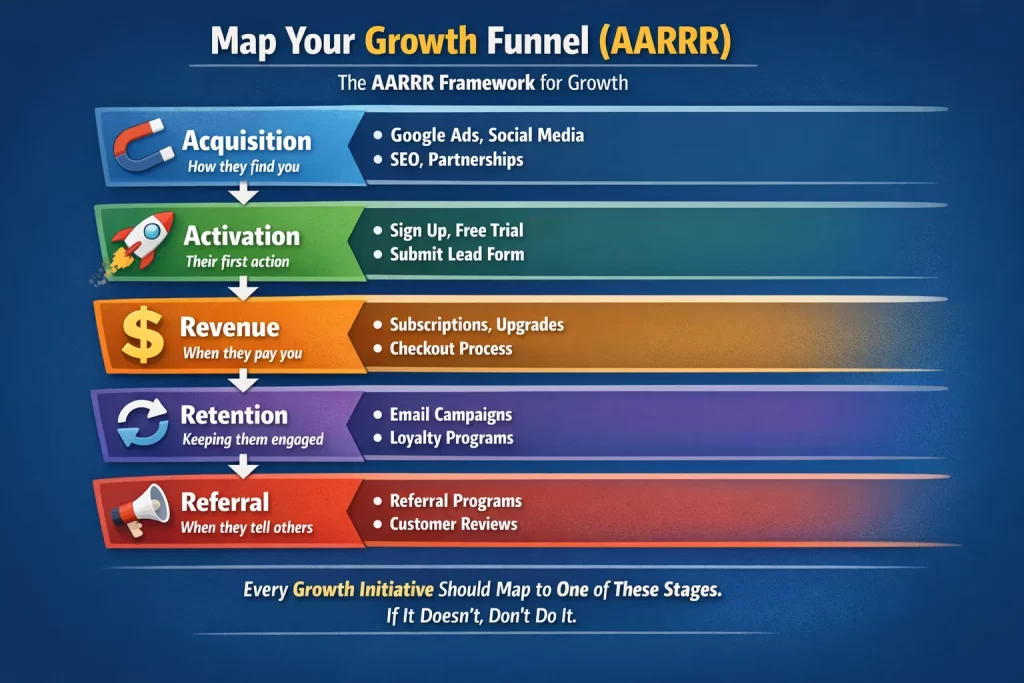
- Acquisition is how people discover you: Google Ads, Meta Ads, SEO, social media, partnerships, whatever brings them in.
- Activation is their first meaningful action: signing up, submitting a lead form, starting a free trial, sending a WhatsApp message.
- Revenue is when they actually pay you: your pricing structure, your sales process, your checkout flow.
- Retention is what brings them back: email sequences, WhatsApp automation, ongoing value delivery, special offers.
- Referral is when they bring others: testimonials, reviews, referral programs.
Every growth initiative you run should clearly map to one of these stages. If it doesn’t, don’t do it.
Step 5: Choose Your Channels Wisely
Not every platform deserves your attention. We recommend the 70-20-10 approach:
Put 70% of your budget into proven channels where you already see results—typically Google Ads, Meta Ads, and SEO. These are your bread and butter.
Allocate 20% to growth channels that show promise—maybe YouTube, LinkedIn, influencer partnerships.
Reserve 10% for pure experiments—new platforms, fresh formats, emerging tools.
This balance keeps your revenue stable while still giving you room to discover what could be your next big channel.
Step 6: Craft an Offer People Actually Want
Traffic without a compelling offer is just expensive noise.
Use this simple formula: “We help [specific audience] achieve [specific outcome] without [their main pain point].”
Your offer should be outcome-driven (focus on the end result, not the process), simple to grasp (if they need to read it three times, it’s too complicated), risk-reducing (guarantees, free trials, money-back promises), and either time-saving or money-saving.
Get your message-market fit right before you scale traffic. Otherwise, you’re just pouring water into a leaky bucket.
Step 7: Optimize for Conversion, Not Just Traffic
Driving thousands of visitors to a page that converts at 0.5%? That’s an expensive way to grow.
Focus on the fundamentals: crystal-clear headlines that lead with benefits, one primary call-to-action (not five), trust elements like reviews and guarantees, fast page load speeds, and forms that ask for the minimum information needed.
Here’s the thing: even a 1% improvement in conversion rate can literally double your profitability. Most businesses ignore this goldmine.
Step 8: Keep Customers Coming Back
Acquiring a customer and then forgetting about them is leaving money on the table—lots of it.
Build retention systems: welcome sequences for new customers, nurturing flows for leads who aren’t ready yet, automated follow-ups for abandoned carts, upsell and cross-sell campaigns when appropriate, and re-engagement sequences for people who’ve gone quiet.
Strong retention increases lifetime value and means you’re not constantly dependent on expensive paid ads to hit your numbers.
Step 9: Run Real Experiments (Not Random Tests)
IDEA
↓
HYPOTHESIS
(What do we believe will improve & why?)
↓
TEST DESIGN
(What to change + who + how many users)
↓
RUN EXPERIMENT
(2+ weeks with proper tracking)
↓
DATA ANALYSIS
(95% confidence + cohort check)
↓
DECISION
├─ Scale (Roll out to all users)
├─ Iterate (Improve & test again)
└─ Kill (Drop the idea)
↓
DOCUMENT LEARNINGS
(So team never repeats mistakes)
↓
NEXT IDEA
Growth marketing lives on systematic experimentation. Each test should follow a clear process: form a hypothesis, run the test, measure results, extract learning, then either scale what worked or kill what didn’t.
The rules are simple: change only one variable per test, run tests long enough to be statistically meaningful, and always base decisions on data, not opinions or politics.
This creates a compounding growth loop where each experiment teaches you something that informs the next one.
Step 10: Track Everything That Matters
You can’t improve what you don’t measure. Without accurate tracking, every growth decision is basically a guess.
Set up the essentials: Google Analytics (GA4), Google Tag Manager for tracking events, proper ad pixels, CRM integration, and heatmaps to see how people actually use your site.
Review performance weekly with a focus on traffic volume, conversions, customer acquisition cost, return on ad spend, and key learnings from tests.
Step 11: Scale Only What’s Proven
Scaling too early kills more businesses than scaling too late.
Scale only when your
- conversion rates are stable and predictable,
- your customer acquisition cost is consistent,
- your offer is performing reliably,
- you have retention systems in place.
When you do scale, do it gradually: increase budgets in small increments, replicate your winning ad creatives, expand keywords and audiences methodically, and launch new landing pages to test fresh angles.
The Bottom Line: Growth Is a System, Not Magic
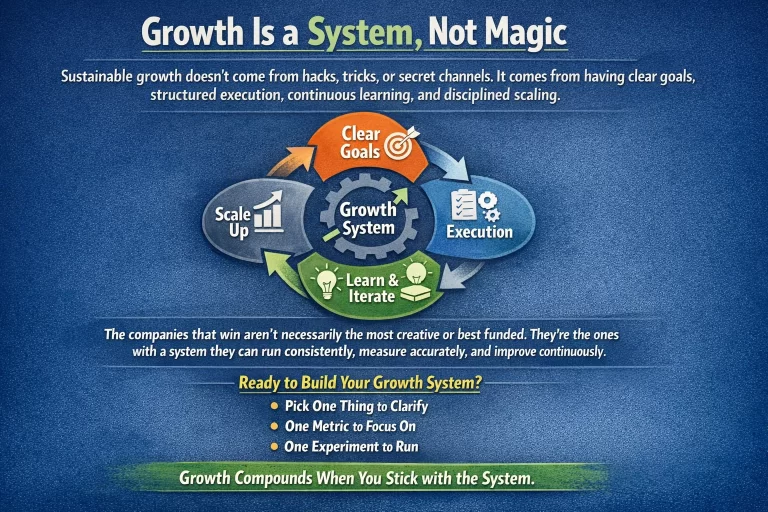
Sustainable growth doesn’t come from hacks, tricks, or secret channels. It comes from having clear goals, structured execution, continuous learning, and disciplined scaling.
The companies that win aren’t necessarily the most creative or best funded. They’re the ones with a system they can run consistently, measure accurately, and improve continuously.
Ready to build your growth system? Start with Step 1 today. Pick one thing to clarify, one metric to focus on, one experiment to run. Then build from there.
Growth compounds when you stick with the system.