Manual CPC Bidding Strategy: Advanced Google Shopping Campaign Control for Experienced Advertisers
Manual CPC (Cost Per Click) bidding represents the traditional approach to Google Ads management, offering granular control over how much you’re willing to pay for each click. At Addeb Solution, we recognize that while automated strategies have largely superseded manual bidding for most advertisers, there are specific scenarios where manual CPC still provides value. This comprehensive guide explores when and how to use manual CPC bidding, while acknowledging the evolution of Google Ads toward automation.
Who Should Read This Guide?
Before diving into manual CPC strategies, let’s clarify who benefits most from this approach. This guide is designed for knowledge-hungry marketers who want to understand all available options, advanced users with substantial existing data even in new accounts, and experienced advertisers comfortable with hands-on campaign management and data analysis.
If you’re completely new to Google Ads and the previous guides on bidding strategies felt overwhelming, we recommend sticking with Maximize Clicks as your starting point. You can safely skip this guide and move forward with campaign setup. However, if you’re eager to understand the full spectrum of bidding options and how manual control works, this guide will provide valuable insights.
The Evolution of Google Ads Bidding
To understand manual CPC’s current role, we need to appreciate how Google Ads has transformed over recent years. At Addeb Solution, we’ve been updating our strategies and training materials for years, and the changes have been dramatic.
How Google Ads Used to Work
In earlier versions of Google Ads, manual CPC was the standard approach for most advertisers. Campaigns required extensive keyword research involving dedicated sections with multiple lectures on keyword discovery, detailed analysis of search volumes for individual keywords, manual evaluation of cost-per-click data for each term, and strategic bidding decisions for every single keyword.
This manual approach demanded significant time investment and deep analytical skills. Advertisers spent hours researching keywords, analyzing competition, and adjusting bids to optimize performance.
The Shift to Automation
Today, Google Ads operates fundamentally differently. Most keywords are completely automated—the system pulls them directly from your product feed rather than requiring manual input. When manual keyword input is allowed, targeting operates on intent-based matching rather than exact keyword control. Automated bidding strategies like Target ROAS have become significantly more powerful and effective than manual approaches.
Google’s machine learning algorithms can now process millions of signals in real-time, making optimization decisions that would be impossible for humans to replicate manually. This shift has democratized advertising success, allowing businesses of all sizes to compete effectively without requiring extensive technical expertise.
Manual CPC’s Diminished Role
Given these advances, manual CPC has become relatively weak compared to automated bidding strategies. This doesn’t mean it’s worthless, but its applications are now much more limited and specialized than in the past. Understanding this context is crucial for making informed decisions about when manual control actually provides advantages.
What Is Manual CPC Bidding?
Manual CPC is a bidding strategy where you set a maximum cost per click that you’re willing to pay for each ad click. Like all Google Shopping strategies, it operates on the PPC (Pay-Per-Click) model—you only pay when someone actually clicks your ad, not when it’s merely displayed.
The defining characteristic of manual CPC is control. You explicitly tell Google, “I’m only willing to pay this much for a click,” and Google respects that ceiling. Your ads won’t appear in auctions where the required bid exceeds your maximum.
The Trade-Off: Control vs. Speed
Manual CPC involves a fundamental trade-off between cost control and data acquisition speed. Understanding this trade-off is essential for deciding whether manual bidding fits your situation.
How Manual CPC Affects Click Volume
When you set a maximum CPC bid, you’re essentially filtering which auctions your ads can participate in. If an auction requires a $2 bid to compete effectively, but you’ve set a $1 maximum, your ad won’t show in that auction.
This filtering has significant implications. You may achieve cheaper clicks on average because you’re only participating in lower-cost auctions. Over an extended timeframe, you might accumulate more total clicks for the same budget. However, click acquisition happens much more slowly because you’re excluding many potential opportunities.
Comparing Maximize Clicks and Manual CPC
Let’s examine how these strategies perform differently in practice. With Maximize Clicks, the algorithm targets all available click opportunities regardless of cost (within your daily budget). It prioritizes speed and volume, getting you data quickly. You may pay more per click on average, but you generate clicks and conversions faster.
With Manual CPC, you restrict the algorithm to specific cost thresholds. This limits targeting opportunities significantly. You’ll acquire data more slowly, potentially spending weeks reaching conversion thresholds that Maximize Clicks achieves in days.
Real-World Performance Example
To illustrate these differences, consider actual campaign data from a recent Addeb Solution client launch. On the first day using Maximize Clicks, the campaign generated 31 clicks at $0.33 per click. Already, this represented a reasonable starting point for data collection.
By day two, performance had improved dramatically: 357 clicks at just $0.03 per click. That’s more than 10X the click volume at one-tenth the cost—a remarkable improvement in just 24 hours.
This rapid optimization occurred because the algorithm had unrestricted access to auction data. Without manual cost limitations, Google’s machine learning could experiment broadly, identify high-performing opportunities quickly, and optimize aggressively.
With manual CPC imposing cost ceilings, this rapid learning and optimization would have been impossible. The algorithm would have been restricted from participating in many auctions, dramatically slowing the learning process.
Why Manual CPC Slows Conversion Acquisition
Remember that reaching 15 conversions within 30 days is your critical goal when starting campaigns. This threshold enables the transition to Target ROAS, where true profit optimization begins.
Manual CPC is objectively the slowest path to this goal. By limiting which auctions you participate in, you reduce overall traffic volume. Lower traffic means fewer conversion opportunities. Fewer conversions means extended time before reaching the 15-conversion threshold.
If Maximize Clicks gets you to 15 conversions in two weeks, manual CPC might take four to six weeks to reach the same milestone. During this extended period, you’re unable to use Target ROAS, meaning you’re missing weeks of potential profit optimization.
The supposed cost savings from manual CPC often prove illusory when you account for the opportunity cost of delayed optimization and slower business growth.
The Power of Leveraging AI
Google’s advertising platform is powered by sophisticated artificial intelligence that processes enormous quantities of data in real-time. This AI considers thousands of signals when determining optimal bids including user search history and behavior patterns, device type and model, geographic location down to neighborhood level, time of day and day of week, weather conditions in the user’s location, and countless other contextual factors.
No human can manually process and act on this volume of information. By imposing manual bid caps, you’re essentially telling this powerful AI, “Ignore much of what you know and restrict yourself to my predetermined limits.”
This approach made sense when Google’s algorithms were primitive. Today, with advanced machine learning, it’s typically counterproductive. The AI can maximize your results far more effectively when given the freedom to operate without artificial constraints.
Advanced Manual CPC Formula
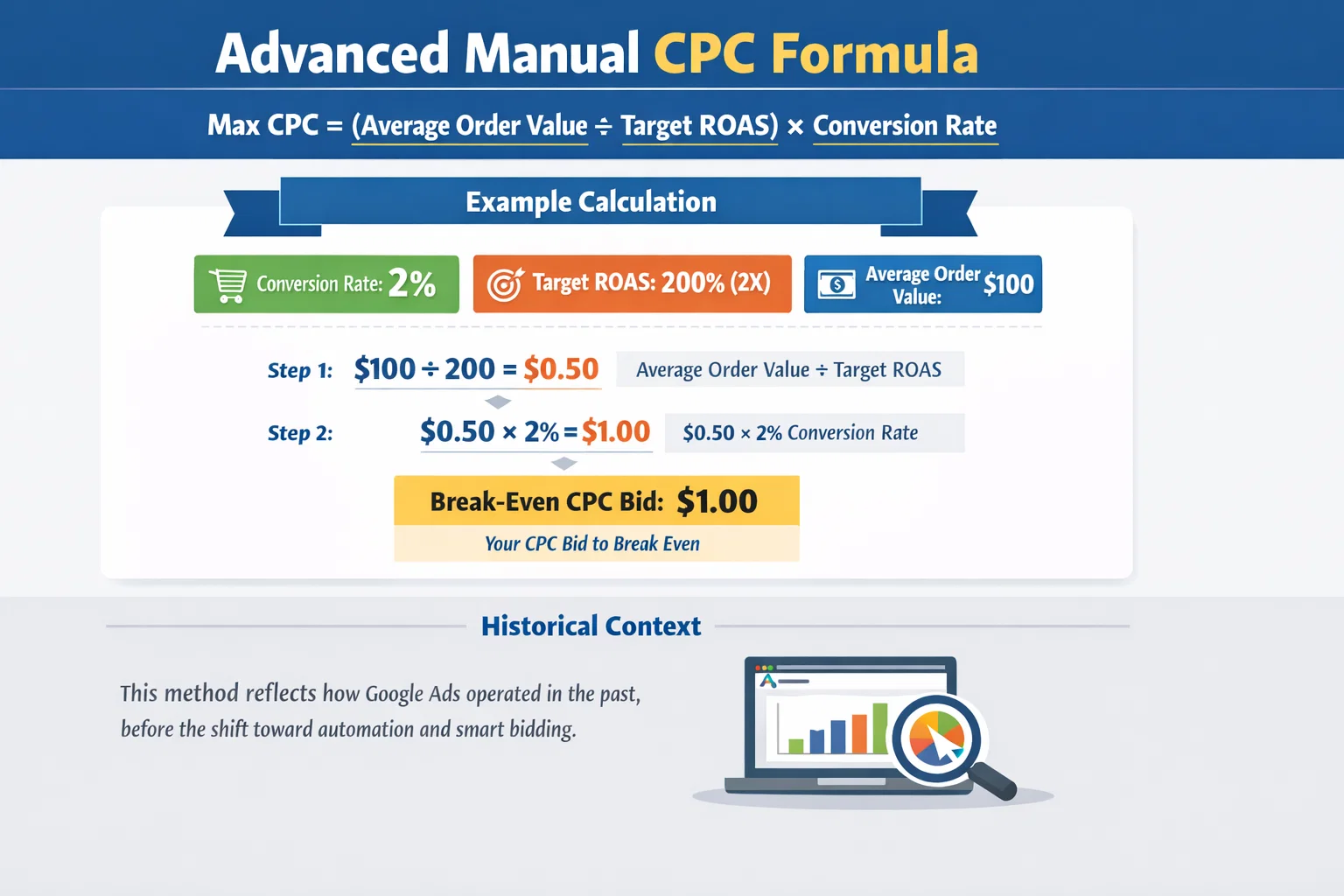
Despite our recommendation to avoid manual CPC for most campaigns, we recognize that some advanced users prefer this approach. If you have substantial data but haven’t yet accumulated conversions, you can calculate an appropriate manual CPC bid using this formula:
Max CPC = (Average Order Value ÷ Target ROAS) × Conversion Rate
Note that this formula requires actual performance data. You need to know your average order value, target return on ad spend, and conversion rate. Without this data, the calculation is impossible.
Formula Example
Let’s work through a practical example to demonstrate how this calculation works. Suppose you have the following data from previous campaigns or industry benchmarks:
- Conversion Rate: 2%
- Break-Even ROAS: 200% (or 2X)
- Average Order Value: $100
First, divide your average order value by your target ROAS:
$100 ÷ 200 = $0.50
Then multiply this result by your conversion rate (use the actual percentage number, not the decimal):
$0.50 × 2 = $1.00
Your break-even CPC bid is $1.00. This means that if you consistently pay $1.00 per click with a 2% conversion rate and $100 average order value, you’ll break even at a 2X ROAS.
Bidding less than $1.00 should theoretically yield profitability. Bidding more would likely result in losses. However, this assumes your conversion rate and average order value remain constant, which rarely happens in reality.
The Historical Context
This type of calculation represents how Google Ads operated just a few years ago. What’s now considered “advanced” knowledge was once standard practice that every advertiser needed to understand and implement. The shift from this being standard to advanced illustrates how dramatically Google Ads has evolved toward automation and simplification.
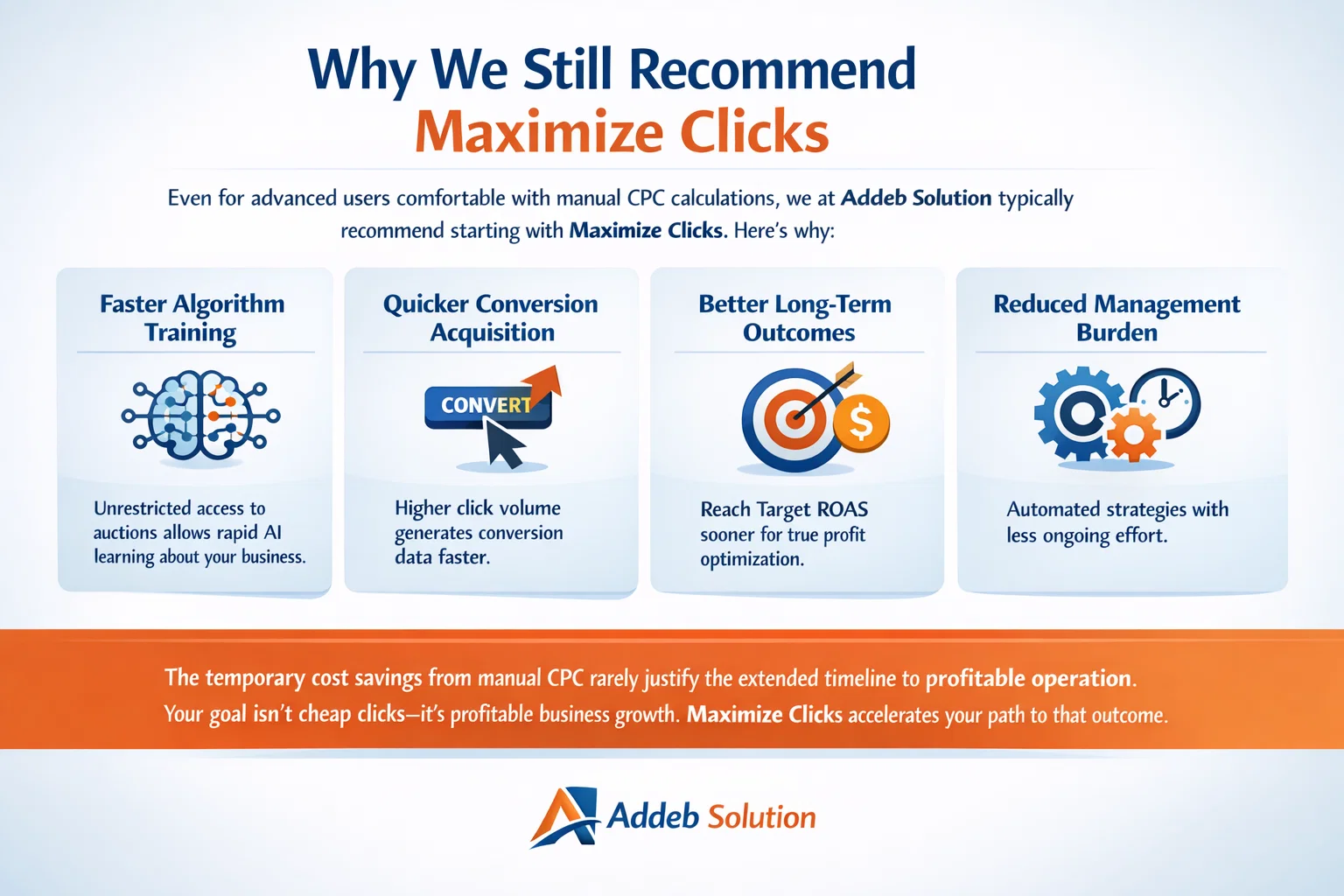
Why We Still Recommend Maximize Clicks
When Manual CPC Might Make Sense
Despite our general recommendation against manual CPC, certain specialized scenarios might warrant this approach:
Extreme Budget Constraints: If your daily budget is very limited and you cannot afford any budget overruns, manual CPC provides absolute cost control.
Existing Extensive Data: If you’re launching a new campaign but have substantial data from previous campaigns in the same niche, you might leverage that data for informed manual bidding.
Testing Specific Cost Thresholds: For advanced optimization experiments, manually controlling CPC allows testing specific hypotheses about bid levels and performance.
Supplement to Other Campaigns: Running a small manual CPC campaign alongside automated campaigns for comparison or specific targeting needs.
Even in these scenarios, manual CPC should be approached with clear goals and realistic expectations about its limitations.
Implementing Manual CPC in Campaign Setup
If you’ve decided to proceed with manual CPC despite the recommendations for automation, here’s how to implement it during campaign creation.
When you reach the bidding strategy selection in your campaign setup, choose “Manual CPC” from the options. Google may offer to set a maximum CPC bid limit. For true manual control, you would typically set this limit based on your calculated break-even CPC or profitability threshold.
However, even if selecting manual CPC, consider leaving the maximum bid limit blank initially. This allows the strategy to function more like Maximize Clicks during the learning phase, giving you data to inform more targeted manual bids later.
The Path Forward
Regardless of your choice between Maximize Clicks and Manual CPC for your initial campaign phase, remember that Target ROAS remains your ultimate destination. That’s where Google Shopping campaigns truly scale and deliver consistent, optimized profitability.
Manual CPC and Maximize Clicks are both temporary strategies designed to accumulate the conversion data necessary for Target ROAS implementation. Given this reality, the strategy that reaches that goal fastest—Maximize Clicks—typically serves most advertisers best.
Conclusion
Manual CPC bidding represents Google Ads’ past more than its present or future. While it offers granular control that appeals to certain advanced users, the dramatic improvements in automated bidding have made manual approaches largely obsolete for most campaigns.
At Addeb Solution, we’ve witnessed this evolution firsthand over years of campaign management. What once required extensive manual keyword research, bid management, and constant optimization now achieves better results with minimal hands-on management through automation.
For new campaigns, our recommendation remains clear: start with Maximize Clicks to rapidly accumulate conversion data, then transition to Target ROAS for profit optimization. This path leverages Google’s advanced AI rather than fighting against it, producing better results in less time with lower management overhead.
Manual CPC has its place for specialized applications and advanced testing, but for the vast majority of Google Shopping campaigns, automation outperforms manual control. Embrace the power of Google’s machine learning, and focus your energy on strategic decisions like product selection, pricing, and landing page optimization rather than granular bid management.
The future of Google Ads is automated, intelligent, and increasingly accessible to businesses of all sizes. By aligning your strategies with this evolution rather than clinging to outdated manual approaches, you position your campaigns for maximum success.