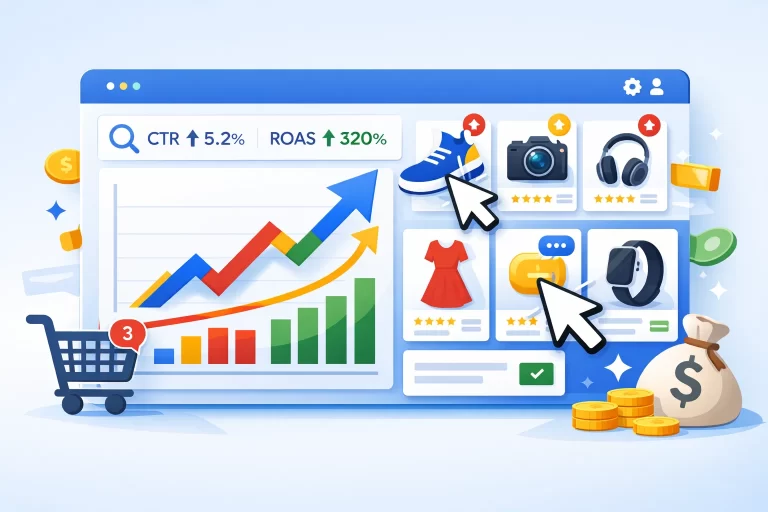
Maximize Clicks Bidding Strategy: The Best Starting Point for New Google Shopping Campaigns
When launching a new Google Shopping campaign, choosing the right bidding strategy can accelerate your path to profitability. At Addeb Solution, we’ve guided hundreds of businesses through their initial campaign launches, and we consistently recommend starting with the Maximize Clicks bidding strategy. This comprehensive guide explains why Maximize Clicks is the optimal starting point and how to use it effectively to build toward long-term success.
What Is the Maximize Clicks Bidding Strategy?
As the name suggests, Maximize Clicks is an automated bidding strategy designed to generate the maximum number of clicks on your ads within your specified budget. Like all Google Shopping bidding strategies, it operates on the PPC (Pay-Per-Click) model, meaning you only pay when someone actually clicks on your ad, not when it’s merely displayed.
This fundamental principle ensures you’re only paying for genuine engagement with your products. While impressions are free, clicks represent real interest from potential customers who want to learn more about what you’re offering.
How Maximize Clicks Works: Volume Over Precision
Understanding the mechanics of Maximize Clicks requires examining the trade-off between traffic volume and traffic quality. This strategy prioritizes reaching as many potential customers as possible, even if it means sacrificing some targeting precision.
The Traffic Quality Spectrum
Imagine a spectrum where one end represents click volume and the other represents traffic quality. Maximize Clicks positions your campaign toward the volume end of this spectrum. Here’s what this means in practical terms:
High Click Volume: The algorithm casts a wider net, targeting broader search queries and less restrictive audience signals to maximize the number of people who see and click your ads.
Lower Traffic Quality: Because targeting is broader, not every click will come from users with high purchase intent. Some visitors will be casually browsing, comparing options, or in early research phases rather than ready to buy.
Budget Efficiency: By accepting lower average quality per click, the strategy generates more clicks for your budget. Each individual click costs less, allowing greater overall reach.
This might initially sound like a disadvantage, but for new campaigns, this approach serves a crucial strategic purpose that outweighs the drawbacks.
Why Maximize Clicks Is Perfect for New Campaigns
The Maximize Clicks strategy isn’t intended to be your permanent bidding approach. Instead, it serves as a strategic stepping stone toward more sophisticated, profit-optimized bidding strategies. Here’s why this matters.
The Path to Target ROAS
As we covered in our previous guide on Target ROAS, that bidding strategy represents the ultimate goal for established campaigns. Target ROAS optimizes for profitability by focusing on return on ad spend. However, Target ROAS requires a critical prerequisite: at least 15 conversions within the last 30 days.
This is where Maximize Clicks becomes invaluable. The strategy’s primary objective is to help you reach that 15-conversion threshold as quickly as possible. By generating high click volume and driving substantial traffic to your store, you accelerate the timeline to your first conversions and build the data foundation necessary for Target ROAS implementation.
Training Google’s Algorithm
Google’s advertising algorithm is incredibly powerful, but it requires data to function effectively. When you launch a brand new campaign, Google knows virtually nothing about your business, your products, or your ideal customers. The algorithm needs to learn who is interested in what you’re selling, what search terms indicate purchase intent, which demographics convert best, what times of day perform optimally, and which devices drive the most sales.
Every click, every site visit, and especially every conversion provides valuable training data. The Maximize Clicks strategy accelerates this learning process by generating substantial interaction volume quickly. More data means faster learning, which leads to better optimization sooner.
Why Not Start with Target ROAS?
You might wonder why not simply start with Target ROAS if that’s the ultimate goal. The answer is simple: it won’t work effectively. Without conversion history, Google has no baseline for understanding what actions lead to sales for your specific business.
Attempting to optimize for return on ad spend without knowing what drives returns is like asking someone to cook a dish they’ve never tasted—they don’t have the necessary reference points to succeed. The algorithm needs to see successful conversions before it can effectively optimize for more of them.
The Algorithm Training Process
Understanding how algorithm training works helps clarify why starting with Maximize Clicks makes strategic sense.
Phase 1: Click Generation (Maximize Clicks)
During this initial phase, Google’s algorithm focuses on generating clicks within your budget. The system learns which search queries trigger your ads, which users click on your ads, what times and locations drive engagement, and how your products compare to competitors.
This phase prioritizes volume and data collection over immediate profitability. You’re investing in education—teaching Google about your business so it can optimize more effectively later.
Phase 2: Conversion Optimization (Target ROAS)
Once you’ve accumulated 15 conversions, you have sufficient data to transition to Target ROAS. Now Google understands who actually buys from you, not just who clicks. The algorithm can identify patterns that distinguish browsers from buyers and optimize specifically for users most likely to convert.
This transition represents a shift from quantity-focused (getting data) to quality-focused (driving profitable sales) optimization. Both phases are essential, and trying to skip the first phase leads to poor performance in the second.
Expected Performance with Maximize Clicks
Setting realistic expectations for your Maximize Clicks phase ensures you don’t become discouraged during this necessary building stage.
What Success Looks Like
During the Maximize Clicks phase, success metrics differ from mature campaigns. You’re not yet optimizing for maximum ROAS or lowest cost per acquisition. Instead, measure success by:
Click Volume: Are you generating substantial traffic within your budget?
Conversion Initiation: Are you starting to see conversions, even if sporadically?
Data Accumulation: Are you building conversion history toward the 15-conversion threshold?
Budget Pacing: Is your budget being spent consistently without excessive spikes or complete depletion?
Timeline Expectations
How long should you expect to run Maximize Clicks before transitioning to Target ROAS? The timeline varies significantly based on several factors including your daily budget, product pricing and appeal, market competition, and search volume for your products.
Some campaigns reach 15 conversions within days, while others may take several weeks. At Addeb Solution, we typically see campaigns accumulate sufficient conversions within 2-4 weeks when budgets are adequate and products have reasonable market fit.
Setting Up Maximize Clicks
When configuring your new shopping campaign, selecting Maximize Clicks is straightforward. After choosing your campaign objective (Sales) and campaign type (Shopping), you’ll reach the bidding strategy selection.
Selecting the Strategy
Look for “Maximize Clicks” in the bidding strategy dropdown menu and select it. Google may recommend other strategies, but for brand new campaigns without conversion history, Maximize Clicks is your optimal starting point.
Budget Considerations
Your daily budget significantly impacts how quickly you reach the 15-conversion threshold. While you want to generate data quickly, you also need to maintain financial sustainability. Consider your product margins and expected conversion rates when setting budgets.
A general guideline: Set a budget that allows for at least 20-30 clicks per day. This provides sufficient traffic volume to generate meaningful data without requiring excessive spending.
Monitoring Your Maximize Clicks Campaign
During the Maximize Clicks phase, focus on specific metrics that indicate progress toward your goal.
Key Metrics to Track
Conversion Count: Your primary metric. How close are you to 15 conversions?
Click-Through Rate (CTR): Indicates ad relevance. Low CTR may signal product feed optimization needs.
Conversion Rate: What percentage of clicks become sales? This reveals landing page effectiveness.
Cost Per Click (CPC): Are you paying reasonable amounts per click relative to your budget and margins?
Impression Share: Are you missing opportunities due to budget constraints or low ad rank?
Optimization Opportunities
Even during the Maximize Clicks phase, you can optimize performance:
Product Feed Quality: Ensure titles, descriptions, and images are compelling and accurate.
Landing Page Experience: Optimize product pages for conversion to maximize value from your traffic.
Negative Keywords: Although shopping campaigns pull keywords automatically, you can exclude irrelevant searches through negative keywords.
Budget Adjustments: If approaching 15 conversions slowly, consider modest budget increases to accelerate data collection.
Common Maximize Clicks Mistakes to Avoid
Many advertisers make predictable mistakes during the Maximize Clicks phase that hinder progress or waste budget.
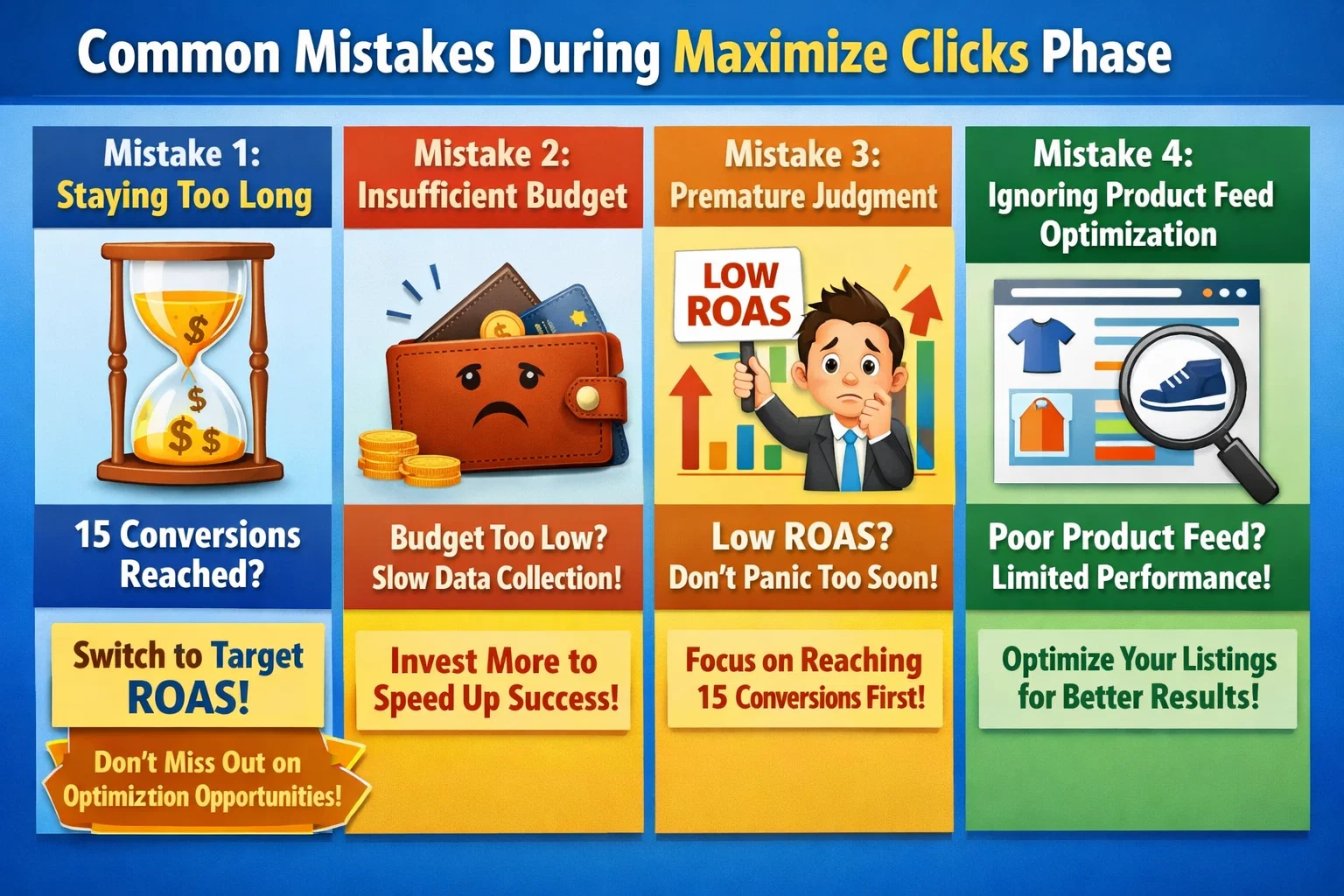
Mistake 1: Staying Too Long
Once you reach 15 conversions in 30 days, transition to Target ROAS promptly. Maximize Clicks served its purpose—continuing indefinitely means missing optimization opportunities and potentially leaving profit on the table.
Mistake 2: Insufficient Budget
Setting budgets too low extends the data collection phase unnecessarily. While budget constraints are real, allocating insufficient funds can mean weeks of inefficient operation when a slightly larger investment would accelerate profitable operation.
Mistake 3: Premature Judgment
Some advertisers panic when initial ROAS is low during Maximize Clicks. Remember: this phase prioritizes data collection, not profitability. Judge success by progress toward 15 conversions, not by immediate returns.
Mistake 4: Ignoring Product Feed Optimization
Even though Maximize Clicks focuses on volume, poor product feeds limit performance. Invest time ensuring your product information is comprehensive and compelling—this improves results during both Maximize Clicks and subsequent phases.
Transitioning from Maximize Clicks to Target ROAS
The transition from Maximize Clicks to Target ROAS represents a critical milestone in your campaign maturity.
When to Transition
Make the switch when you’ve accumulated 15 conversions within the last 30 days. Don’t wait significantly longer—the sooner you transition after meeting the threshold, the sooner you begin optimizing for profitability rather than just data collection.
How to Transition Smoothly
Navigate to your campaign settings, change the bidding strategy from Maximize Clicks to Target ROAS, and set your initial target at your break-even ROAS (calculated using the formula: 1 ÷ profit margin).
Allow 7-14 days for the algorithm to adjust to the new optimization goal. Performance may fluctuate initially as Google recalibrates its approach from maximizing clicks to maximizing return on ad spend.
Post-Transition Optimization
After transitioning, monitor performance closely. If you’re consistently meeting or exceeding your break-even ROAS, gradually increase your target to improve profitability. If you’re falling short, consider lowering the target slightly or investigating conversion barriers on your site.
Alternative Starting Strategies
While Maximize Clicks is our recommended starting point for most new campaigns, some advertisers prefer Manual CPC bidding. We’ll explore this alternative in our next guide, which covers advanced manual bidding strategies for experienced advertisers who want granular control over their campaigns.
However, for businesses new to Google Ads or those seeking efficient, automated campaign management, Maximize Clicks remains the superior starting point. It balances data collection speed, ease of management, and reasonable cost control.
Conclusion
The Maximize Clicks bidding strategy is not just a stopgap measure—it’s a strategic foundation that sets your campaigns up for long-term success. By prioritizing data collection and algorithm training, you’re investing in the future performance of your advertising.
At Addeb Solution, we view the Maximize Clicks phase as essential groundwork. Yes, immediate returns may be modest compared to mature campaigns, but the data you gather and the algorithm training you facilitate during this period directly enable the profitable, scalable campaigns you’ll run later with Target ROAS.
Remember that every successful Google Shopping campaign begins somewhere. The brands achieving impressive returns today all went through this initial phase of building data and training algorithms. By starting with Maximize Clicks, you’re following the proven path to advertising success.
Embrace this phase as a necessary investment rather than an inconvenience. Generate those 15 conversions, train Google’s algorithm to understand your business, and prepare for the transition to profit-optimized bidding. Your patience during the Maximize Clicks phase pays dividends through better performance in all future campaign phases.