Target ROAS Bidding Strategy: Complete Guide to Maximize Google Shopping Profitability
Choosing the right bidding strategy can mean the difference between profitable Google Shopping campaigns and wasted ad spend. At Addeb Solution, we’ve helped countless businesses navigate the complexities of Google Ads bidding to achieve sustainable profitability. In this comprehensive guide, we’ll explore Target ROAS (Return on Ad Spend), one of the most powerful automated bidding strategies available for shopping campaigns.
Understanding Google Shopping Bidding Strategies
Before diving into Target ROAS specifically, it’s important to understand the bidding landscape. Google currently offers three primary bidding strategies for shopping campaigns, and while Google occasionally introduces new options or renames existing ones, these core strategies have remained consistent for over a decade:
Target ROAS (automated bidding strategy) Maximize Clicks (automated bidding strategy) Manual CPC (manual bidding strategy)
Each strategy serves different purposes and works best in specific scenarios. Among these options, there’s one clear winner for most established campaigns, and understanding when and how to use it is crucial for your advertising success.
What Is Target ROAS and How Does It Work?
Target ROAS is an automated bidding strategy that operates on the PPC (Pay-Per-Click) model. This means you only pay when someone actually clicks on your ad, not when it’s displayed. This fundamental principle makes Google Ads incredibly cost-effective—you’re only paying for actual engagement with your products.
Defining Return on Ad Spend
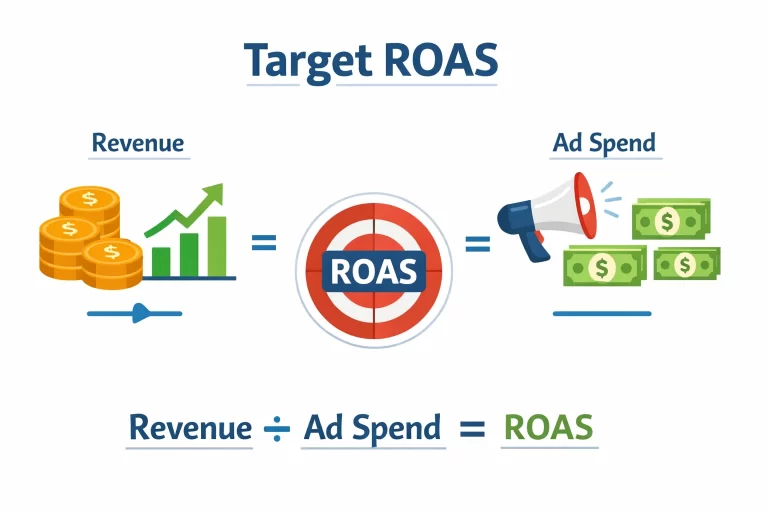
ROAS stands for Return on Ad Spend, which measures how much revenue you generate for every dollar spent on advertising. It’s one of the most important metrics in digital advertising because it directly ties your marketing investment to business results.
The calculation is straightforward:
ROAS = Revenue ÷ Ad Cost
Practical ROAS Examples
Let’s examine how this works with real numbers. Suppose your shopping campaign generates $500 in revenue, and you spent $100 on ads to achieve that result. Your ROAS calculation would be:
$500 ÷ $100 = 5 (or 500%)
This means you’re getting $5 back for every dollar invested in advertising. In other words, your return on ad spend is 5X or 500%. This is typically expressed as “getting $5 for every $1 spent”—a common way advertisers discuss ROAS performance.
How Target ROAS Automation Works
When you select Target ROAS as your bidding strategy, you’re telling Google’s algorithm what return you want to achieve. Google then automatically adjusts your bids in real-time to reach that target. The system analyzes countless signals—user behavior, device type, location, time of day, search intent, and historical performance—to determine the optimal bid for each auction.
This automation removes the burden of manual bid management while theoretically optimizing for your profitability goals. However, as we’ll discover, there are important nuances and prerequisites for success.
The Optimal ROAS Sweet Spot
One of the most critical concepts to understand is that every product has an optimal Target ROAS. Setting your target too high or too low both lead to poor results, but for different reasons.
Understanding the ROAS Curve
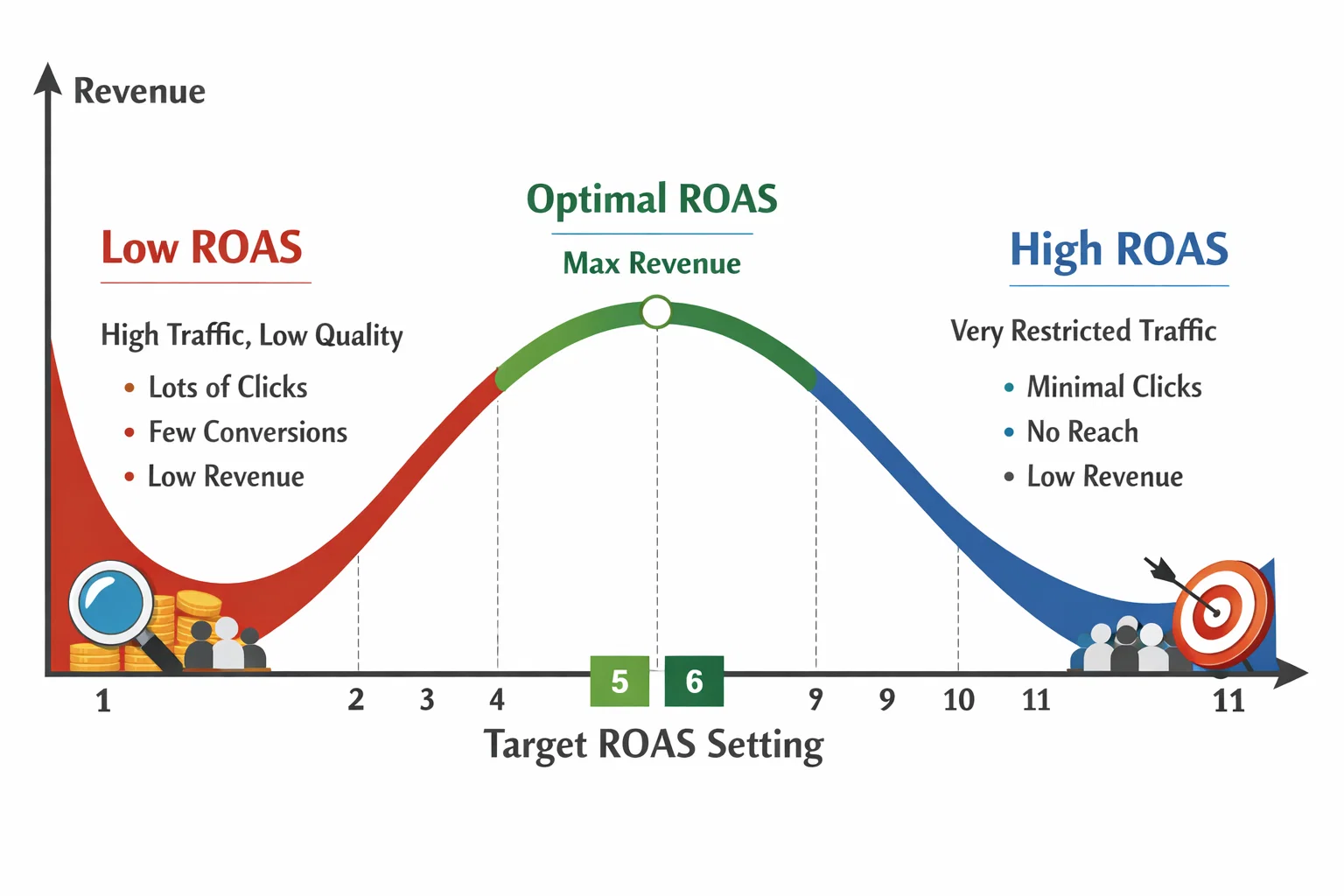
Imagine a graph where the vertical axis represents revenue and the horizontal axis represents your Target ROAS setting from 1 to 11. This creates a curve that reveals important insights about traffic quality and volume.
At Low ROAS (Setting of 1):
- Extremely high search volume and traffic
- Very broad targeting with low-quality traffic
- Users aren’t particularly interested in purchasing
- High clicks but minimal conversions
- Result: Low revenue despite high traffic
At High ROAS (Setting of 11):
- Extremely low search volume and traffic
- Ultra-restrictive targeting
- Not enough potential customers to reach
- Very few clicks and minimal opportunities
- Result: Low revenue due to insufficient traffic
At Optimal ROAS (Often Around 5-6):
- Balanced traffic volume and quality
- Targeted audience with genuine purchase intent
- Sufficient reach to generate meaningful results
- Result: Maximum revenue generation
The exact optimal point varies significantly based on several factors including your product’s search volume, keyword competition costs, profit margins, and target market. There’s no universal “perfect” ROAS—it must be discovered through testing and optimization.
Calculating Your Break-Even ROAS
Since we don’t initially know the optimal ROAS for any given product, where should you start? The answer lies in calculating your break-even ROAS—the point where you’re neither making money nor losing it.
The Break-Even Formula
Break-Even ROAS = 1 ÷ Profit Margin
This simple formula provides your starting point for ROAS targeting. Let’s explore how this works with different profit margins.
Example 1: 20% Profit Margin
Suppose your product has a 20% profit margin after accounting for cost of goods sold, shipping, manufacturing, and other expenses. Your break-even ROAS would be:
1 ÷ 0.20 = 5
This means you need at least a 5X return on ad spend to break even. At this ROAS, you’re not making profit from advertising, but you’re covering all costs and maintaining a sustainable operation.
Example 2: 50% Profit Margin
If your product has a healthier 50% profit margin, your calculation changes significantly:
1 ÷ 0.50 = 2
With higher margins, you only need a 2X return to break even, making it much easier to achieve profitability. This is why profit margins are so crucial in determining advertising viability.
Determining Your Profit Margin
Accurately calculating your profit margin is essential for setting realistic ROAS targets. Your approach depends on your product catalog size.
For Small Catalogs (1-10 Products)
Calculate the profit margin for each product individually, then determine the average profit margin across all products. Since you have few products, this average provides a reliable baseline for your ROAS calculations.
Consider all costs when calculating margins including product cost from supplier, shipping to customer, payment processing fees, returns and refunds, packaging materials, and any other direct product costs.
For Large Catalogs (10+ Products)
With numerous products, calculating individual margins becomes impractical. Instead, focus on your Average Order Value (AOV)—the average amount customers spend per transaction on your site.
Calculate the profit margin based on this average order value rather than individual products. This approach accounts for the reality that you can’t predict exactly which products customers will purchase, but you can use aggregate data to determine overall profitability.
Why Not Every Product Works with Google Ads
Understanding break-even ROAS reveals an uncomfortable truth: not every product will be profitable through Google Shopping Ads. In fact, many products simply won’t work, and testing is the only way to determine viability.
The Profit Margin Constraint
Consider a product with a 20% profit margin requiring a break-even ROAS of 5. If testing reveals that the optimal ROAS for this product is actually 4—meaning increasing beyond 4 drastically reduces traffic and revenue—this product becomes unviable for advertising.
At a 4X ROAS with 20% margins, you’re losing money on every sale generated through ads. No amount of optimization or budget adjustment can overcome this fundamental mismatch between product economics and market conditions.
When Products Are Scalable
Conversely, some products have favorable economics. If your break-even ROAS is 5 and testing shows you can maintain or exceed this while scaling traffic, you’ve found a winner. These products allow you to increase budgets, drive more traffic, and generate proportional or better returns—the holy grail of profitable advertising.
The only way to identify which category your products fall into is through systematic testing and data analysis. At Addeb Solution, we emphasize the importance of treating initial campaigns as experiments that reveal product viability, not just immediate profit generators.
The Critical Prerequisite: 15 Conversions in 30 Days
Despite Target ROAS being the optimal bidding strategy for established campaigns, it’s not appropriate for brand new accounts or campaigns. There’s a critical requirement that must be met first.
Why Conversion History Matters
Target ROAS relies on Google’s machine learning algorithms to optimize bids. These algorithms need data—specifically conversion data—to understand your audience, identify patterns, and make intelligent bidding decisions.
Without sufficient conversion history, the algorithm is essentially guessing. It doesn’t know who your customers are, what signals indicate purchase intent, or how much you should bid to achieve your target returns.
The 15-Conversion Threshold
Google recommends having at least 15 conversions within the last 30 days before implementing Target ROAS. This threshold provides enough data for the algorithm to identify meaningful patterns and optimize effectively.
Attempting to use Target ROAS with insufficient conversion history typically results in poor performance including unstable costs per click, inconsistent ad delivery, failure to reach target ROAS, and wasted budget while the algorithm “learns.”
Alternative Starting Strategies
If you’re launching a new campaign or don’t yet have 15 conversions in the past 30 days, you’ll need to begin with a different bidding strategy. The goal during this initial phase is to generate those first conversions efficiently while gathering the data necessary to eventually transition to Target ROAS.
Common starting strategies include Manual CPC bidding, which gives you direct control over maximum costs per click, and Maximize Clicks, which aims to generate the most clicks within your budget to accelerate data collection. We’ll explore these alternatives in depth in subsequent guides.
Best Practices for Target ROAS Success
Once you’ve met the conversion threshold and implemented Target ROAS, follow these best practices from Addeb Solution to maximize performance:
Start at Break-Even: Begin with your calculated break-even ROAS, then gradually increase as performance data accumulates.
Make Gradual Adjustments: Change your Target ROAS in small increments (0.5 to 1.0 at a time) to avoid disrupting the algorithm’s learning.
Allow Time for Optimization: After each adjustment, wait at least 7-14 days before making additional changes. The algorithm needs time to adapt.
Monitor Performance Closely: Track not just ROAS but also total revenue, conversion volume, and impression share to ensure you’re not overly restricting traffic.
Segment by Product Performance: Different products may perform optimally at different ROAS targets. Use campaign structure to accommodate these differences.
Consider Seasonality: Adjust expectations during peak and off-peak seasons as optimal ROAS may fluctuate with market conditions.
When Target ROAS Isn’t Working
If you’ve implemented Target ROAS with sufficient conversion history but aren’t seeing desired results, consider these troubleshooting approaches:
Verify Profit Margin Calculations: Ensure your break-even ROAS calculation includes all actual costs. Underestimating costs leads to targets that appear profitable but aren’t.
Check Search Volume: Some products simply don’t have sufficient search volume to support aggressive ROAS targets. Lower your target or consider if the product is viable for advertising.
Review Product Feed Quality: Poor product titles, descriptions, or images reduce relevance and hurt performance regardless of bidding strategy.
Analyze Competitive Landscape: Highly competitive markets may require accepting lower ROAS or finding ways to differentiate your offering.
Examine Landing Page Experience: Conversion rate problems can make even optimal targeting appear ineffective.
The Path to Profitability
Target ROAS represents the end goal for most Google Shopping campaigns—an automated, data-driven approach to maximizing profitability. However, reaching this goal requires patience, proper setup, and sufficient conversion data.
Understanding the relationship between profit margins, ROAS targets, and product viability empowers you to make informed decisions about which products to advertise and how aggressively to pursue different ROAS levels.
Conclusion
Target ROAS is a powerful bidding strategy that can transform profitable products into consistently performing revenue drivers. By understanding break-even calculations, optimal ROAS concepts, and the prerequisites for success, you’re equipped to implement this strategy effectively when the time is right.
At Addeb Solution, we guide businesses through the entire journey—from initial campaign launch with appropriate starter strategies, through the data collection phase, and finally to implementing and optimizing Target ROAS for maximum profitability.
Remember that success with Target ROAS isn’t immediate. It requires meeting conversion thresholds, understanding your product economics, and continuously optimizing based on performance data. But for products with viable economics and sufficient market demand, it’s the most efficient path to sustainable, scalable advertising profitability.
In our next guide, we’ll explore the alternative bidding strategies you should use when starting your campaigns or when Target ROAS prerequisites aren’t yet met. These strategies help you efficiently generate those critical first conversions while maintaining cost control.